Showing posts with label Lecture Series. Show all posts

Monday, January 12, 2026

Retractions: On the Rise, But Not Enough

Dear All, 

We are delighted to inform you that Department of Library & Information Science, Central University of Tamil Nadu (CUTN), Thiruvarur, organised a special online lecture under its series “Gyan Pravah: Online Lecture Series in LIS." The 10th lecture in the series was held on 7th January 2026 (Wednesday) from 06:30 PM to 07:30 PM via Google Meet. Dr. Ivan Oransky, MD, Co-Founder of Retraction Watch and Executive Director of the Center for Scientific Integrity, was invited as the resource person and delivered a lecture on the topic “Retractions: On the Rise, But Not Enough.” 

The programme commenced with a welcome address, followed by the introduction of the speaker by Prof. S. Thanuskodi, Professor & Head of the Department of Library and Information Science, Central University of Tamil Nadu, Thiruvarur who highlighted the speaker’s contributions to research integrity and scholarly publishing.

The invited speaker, Dr. Ivan Oransky, delivered a one-hour lecture focusing on the role of retractions in correcting the scholarly record and maintaining public trust in research. He emphasized that retractions are intended to correct the literature rather than punish authors, and that despite an increase in retractions, they are still not sufficient in proportion to the volume of unreliable research. During the lecture, Dr. Oransky discussed why retractions matter, particularly in cases of large-scale falsification and editorial failures that risk undermining confidence in science. He explained what gets retracted and who decides, noting that editors may retract publications when confidence in the results is lost, in line with established publication ethics guidelines. The speaker outlined common reasons for retractions, including duplication, plagiarism, image manipulation, faked data, fake peer review, publisher errors, authorship issues, legal reasons, paper mills, and voluntary retractions undertaken as an act of doing the right thing. He clearly distinguished between research misconduct, fabrication, falsification, and plagiarism, and honest error, emphasizing that honest mistakes and differences of opinion do not constitute misconduct. An emerging trend discussed during the session was the appearance of AI-generated or AI-assisted writing in papers and peer-review reports. Dr. Oransky emphasized the importance of transparency and careful editorial judgment in handling such cases. He also cautioned that ranking systems and policy frameworks that penalize retractions may discourage responsible self-correction and transparency. The lecture was followed by an interactive Q&A session, during which participants engaged in discussions related to retraction practices, research misconduct, AI in scholarly publishing, and research evaluation systems.

The programme was coordinated by Dr. Anila Sulochana, Assistant Professor, Department of Library and Information Science, Central University of Tamil Nadu, and attended by more than 40 participants. The session concluded with a formal vote of thanks proposed by Dr. S. Ravikumar, Associate Professor, Department of Library and Information Science, Central University of Tamil Nadu, who thanked the speaker and participants for their valuable contributions. 

The virtual invited talk was informative and beneficial to faculty members, research scholars, and students, offering important insights into contemporary challenges in scholarly communication and research integrity.

Sunday, August 31, 2025

From Paywalls to Free Walls: Concepts and Practice of Open Access Publishing

Dear All,

We are delighted to inform you that Department of Library & Information Science, Central University of Tamil Nadu (CUTN), Thiruvarur, organised a special online lecture under its series “Gyan Pravah: Online Lecture Series in LIS." The 9th lecture in the series was held on 30th August 2025 (Saturday) from 03:00 to 04:20 PM via Google Meet. Dr. Mohammad Nazim, Associate Professor, Department of Library and Information Science, Aligarh Muslim University, Aligarh, was invited as the resource person and delivered a lecture on the topic “From Paywalls to Free Walls: Concepts and Practice of Open Access Publishing.”


The program commenced with a welcome address and opening remarks by Prof. S. Thanuskodi, Head, Department of Library and Information Science, CUTN, followed by a brief introduction to the department. Prof. Akhandanand Shukla, Department of Library and Information Science, CUTN, introduced the resource person, highlighted the importance of the lecture, and provided an overview of the theme.

In his talk, Dr. Nazim covered a wide range of themes, including scholarly publishing and the research cycle, paywall and free-wall models of communication, the evolution of the Open Access (OA) movement, routes of OA publishing, credible platforms and tools, predatory journals, and strategies for making research openly accessible. He discussed the limitations of traditional publishing models, explaining how authors often transfer their rights to publishers and how readers, despite paying subscription fees, are frequently granted little or no reuse rights beyond basic access. He emphasized that paywall publishing slows scientific progress and reduces the return on public investment in research. While introducing the concept of OA publishing, he addressed common myths, clarifying that OA does not equate to low-quality research. Many reputed journals and funding agencies support OA, and most OA journals are peer-reviewed and indexed. He compared paywalled and OA publishing models, outlining their respective benefits and drawbacks. He also highlighted the “One Nation One Subscription” policy and the role of libraries in ensuring equitable access to scholarly information worldwide.

Dr. Nazim elaborated on the different routes of OA publishing and explained the publishing cycle of each route, along with their advantages and limitations. He emphasized the importance of self-archiving research, discussed preprint versions of papers and Article Processing Charges (APCs), and introduced well-known OA repositories such as SHERPA-RoMEO and the Directory of Open Access Journals (DOAJ). Citing data from Royal Society Publishing, he demonstrated that articles published in OA receive 100% more citations and 116% more downloads than subscription-based articles. He emphasized that “open access means more reach and more impact” as it increases visibility, fosters global collaboration, and enhances the reputation of researchers and institutions.

At the same time, he acknowledged the challenges of OA publishing, including APCs, predatory journals, and copyright and licensing issues. To address these, he provided a checklist for evaluating OA journals, recommending that credible journals should clearly describe their peer-review process, be listed in DOAJ or UGC-CARE, maintain transparent APC policies, and have editorial boards comprising genuine scholars. He also explained Creative Commons (CC) licenses, outlining types such as CC-BY, CC-BY-SA, CC-BY-NC, and CC-BY-ND, and elaborated on their significance in scholarly communication. Furthermore, he introduced several free tools supporting OA research—including Unpaywall, Open Access Button, CORE, Zenodo, and the Open Science Framework (OSF)—and demonstrated their utility in enhancing research visibility and accessibility. In conclusion, he presented case studies showcasing success stories that demonstrated how OA enhances research visibility and highlighted the transformative role of institutional repositories in disseminating scholarly outputs. During the interactive Question–Answer session, Dr. Nazim responded to several queries.
 
The program, designed for Library and Information Science (LIS) professionals, witnessed active participation from faculty members, research scholars, and students of CUTN as well as other institutions. The lecture was coordinated by Prof. Akhandanand Shukla, Department of Library and Information Science, CUTN, and attended by more than 70 participants. The session ended with concluding remarks and a formal vote of thanks proposed by Dr. S. Ravi Kumar, Associate Professor, DLIS, CUTN, who expressed gratitude to the resource person, organizers, and participants for their valuable contributions in making the lecture a success. Ms. Komal Sahu, Senior Research Fellow, served as the rapporteur of the program.

Glimpses of the program are given below:


Department thanks to all who attended the program and taken the benefit to listen Dr. Mohammad Nazim on the important aspects of open access publishing.

Monday, August 11, 2025

Understanding Systematic Literature Review

Dear All, 

We are delighted to inform you that Department of Library & Information Science, Central University of Tamil Nadu, Thiruvarur has organised a special online lecture series “Anveshan: An Online Lecture Series in LIS for Research Scholars." The 10th lecture in the series was held on 9th August 2025 (Saturday) from 03:00 to 04:30 PM via Google Meet. Prof. Shriram Pandey, Professor & Head, Department of Library and Information Science, Central University of Haryana, Mahendergarh, was invited as the resource person and delivered a lecture on the topic “Understanding Systematic Literature Review.”

The programme commenced with a welcome address by Prof. Akhandanand Shukla, DLIS, CUTN, followed by a brief introduction to the programme, the department, its faculty members, and the resource person. 

In his lecture, Prof. Pandey highlighted the growing importance of systematic review papers and their increasing demand in scholarly publications across various domains. He emphasised that systematic reviews are fundamentally different from bibliometric studies and require collaboration and subject expertise. He outlined the purpose of systematic reviews and discussed common mistakes in literature reviews, such as adopting a “pick and choose” approach from a single database, organising literature solely in chronological, reverse chronological, or thematic order, and relying on a single database or dataset to identify research gaps. Further, he explained the key benefits and challenges of systematic reviews, noting their role in identifying prolific authors and establishing relationships among research contexts—something traditional reviews often fail to achieve. He clarified the differences between a literature review, a systematic literature review, and a meta-analysis, and discussed various types of literature reviews and review methods. 

Prof. Pandey stressed that a literature review is a journey from the known to the unknown, making it essential to adopt the correct methodology. He demonstrated various sources of data for systematic reviews, including bibliographic databases, websites, journals, and books. He explained how to develop a search strategy using synonyms, abbreviations, and Boolean operators, and presented the standard format of a systematic literature review paper. He particularly stressed the adoption of the PRISMA methodology, which he described in detail. Additionally, he discussed methods of data extraction and analysis, including descriptive analysis and literature classification, and outlined the sequential steps for conducting systematic reviews. He also shared examples of both paid and free tools useful for this process. Towards the end of the session, Prof. Pandey gave a practical demonstration of conducting a systematic review. During the question-and-answer session, participants raised queries about the limitations of keywords in titles and the restrictions of search results in open-access databases, which he addressed comprehensively.
The lecture was coordinated by Prof. Akhandanand Shukla, DLIS, CUTN, and attended by 48 participants. Dr. K. G. Sudhier, Assistant Professor, shared his insights on the topic and delivered the formal vote of thanks. Ms. Komal Sahu, Senior Research Fellow, served as rapporteur for the programme.

The glimpses of the program is given below: 


Department thanks to all who attended the program and taken the benefit to listen Prof. Shriram Pandey on the important aspects of literature review.

Thursday, February 24, 2022

How to Talk Without Fear

Dear All,

This is to inform you that the Department of Library and Information Science, Central University of Tamil Nadu has initiated a talk series on Career Guidance and Counseling (CGC). This series of talks is intended to improve the soft skills of students. The first talk in the series was held on 19th February 2022 (Saturday) at 3:00 PM through Google Meet. Ms. A. Poomagal, Assistant Professor, St. Joseph’s College of Arts and Science, Cuddalore, Tamil Nadu has been invited as a speaker and she delivered a talk on "How to Talk Without Fear".


At the outset, Dr. Akhandanand Shukla, Associate Professor, and Head, Department of Library and Information Science, CUTN cordially welcomed all. Dr. Anila Sulochana introduced the speaker to the audience.

“How to Talk Without Fear” was focused mainly on communications skills. The session started with the communication skills required for addressing an interview. The discussion is continued covering the presentation skills focusing on communication. The session ended with discussion on queries related to answering the interview questions, addressing the interview board, etc.

The talk was coordinated by Dr. Anila Sulochana, Assistant Professor and Placement Coordinator for the Department of Library and Information Science, and attended by 32 participants. Dr. V. K. Dhanyasree, Assistant Professor has summarized the session. The session ended with a formal vote of thanks proposed by Dr. Anila Sulochana.

Glimpses of the program are given below:


Department congrats to all who attended the program and took the benefit to listen to Ms. A. Poomagal on one of the important aspects of soft skill development.

Thanks.

Monday, July 26, 2021

Searching and Review Tools in Research: A Practical Approach

Dear All,

This is to inform you that Department of Library and Information Science, Central University of Tamil Nadu has organised a special online lecture series Anveshan: Online Lecture Series in LIS for Research Scholars. The ninth online lecture in the series was organised on 22nd July, 2021 (Thursday) at 3:00 PM through Google Meet. Dr. Mayank Yuvaraj, Assistant Librarian, Central University of South Bihar, Gaya has been invited as resource person and he delivered a lecture on "Searching and Review Tools in Research: A Practical Approach".


The program commenced with a welcome address given by Dr. Akhandanand Shukla, Associate Professor and Head, Department of Library and Information Science, CUTN Thiruvarur followed by a brief introduction about the resource person.

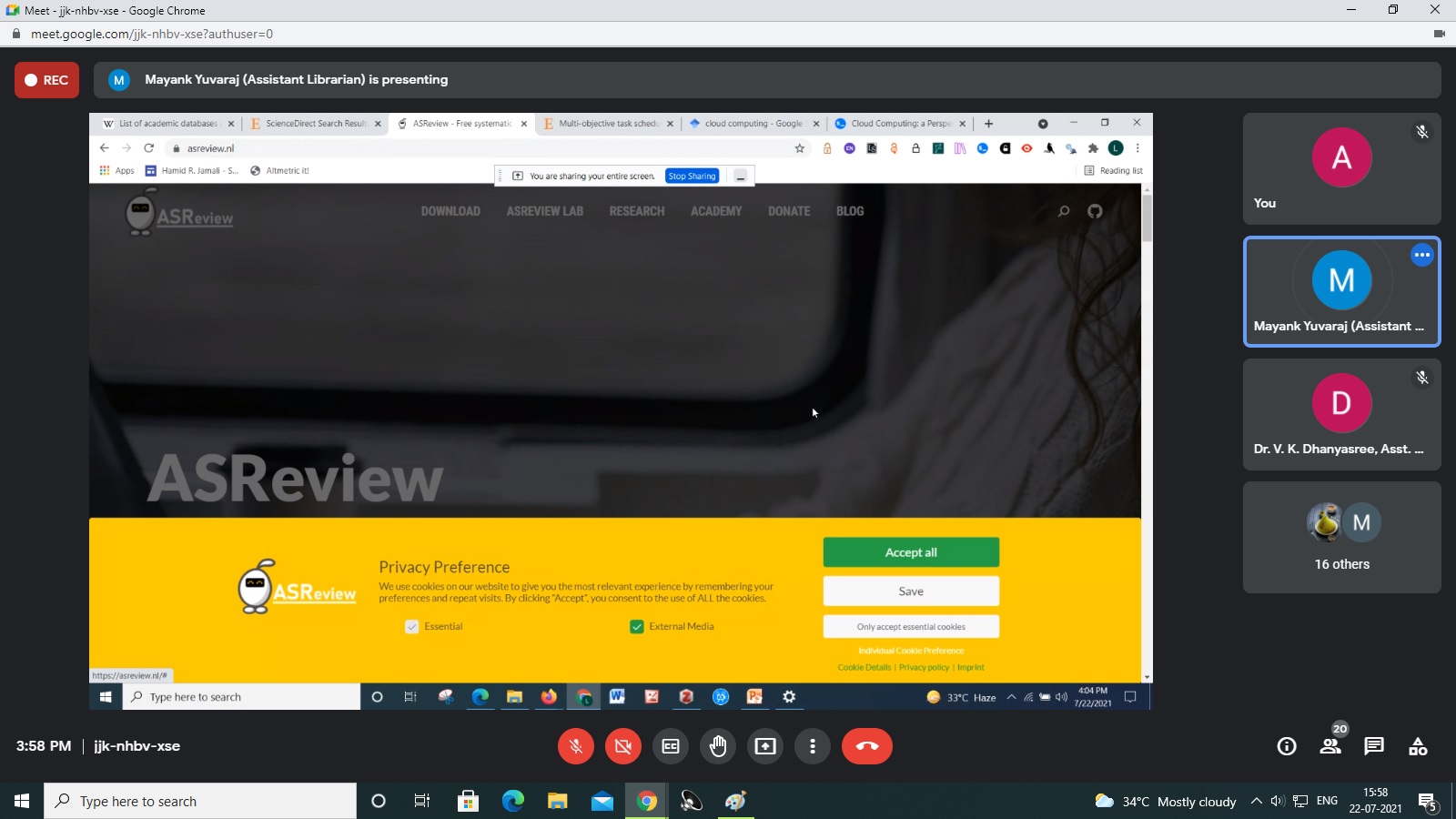
Dr. Mayank Yuvaraj started his talk with a brief introduction to Push and Pull information seeking technologies and elaborated on it through a virtual experience using Google Scholar and other academic search engines. Dr. Yuvaraj expressed his concern over how the advanced features of Google Scholar is not being used to its full potential and educated the participants on these features like labeling the documents, adding documents to “My Library” etc. through a live demonstration. He went on to explaining about various Google Chrome extensions like Core Discovery, Endnote Click, Google Scholar Button, Scholarcy etc. He gave a hands-on training session on adding these extensions and using them to the right potential. Dr. Mayank Yuvaraj then moved on to the literature review techniques using Citation Gecko and Inciteful.xyz. He demonstrated the functioning of these techniques through a live practical session. He carried on by talking about literature review through artificial intelligence wherein he discussed about various OSS for literature review through artificial intelligence which include ASReview, Fastread, Abstrackr etc. He concluded the lecture with a detailed demonstration of ASReview. An active Q&A session took place thereafter.

The lecture was coordinated by Dr. V. K. Dhanyasree, Assistant Professor, Department of Library and Information Science, Central University of Tamil Nadu, Thiruvarur and attended by 26 participants. Dr. Akhandanand Shukla, Associate Professor and Head shared his insights on the topic. The lecture session ended with a formal vote of thanks delivered by Dr. V. K. Dhanyasree. Ms. Nayanthara S., Research Scholar, worked as rapporteur in the program.

The glimpses of the program is given below:


Department congrats to all who attended the program and taken the benefit to listen Dr. Mayank Yuvaraj on practical aspects of literature review.

Thanks.

Tuesday, July 20, 2021

Knowledge Management for Development: The ABCs

Dear All,

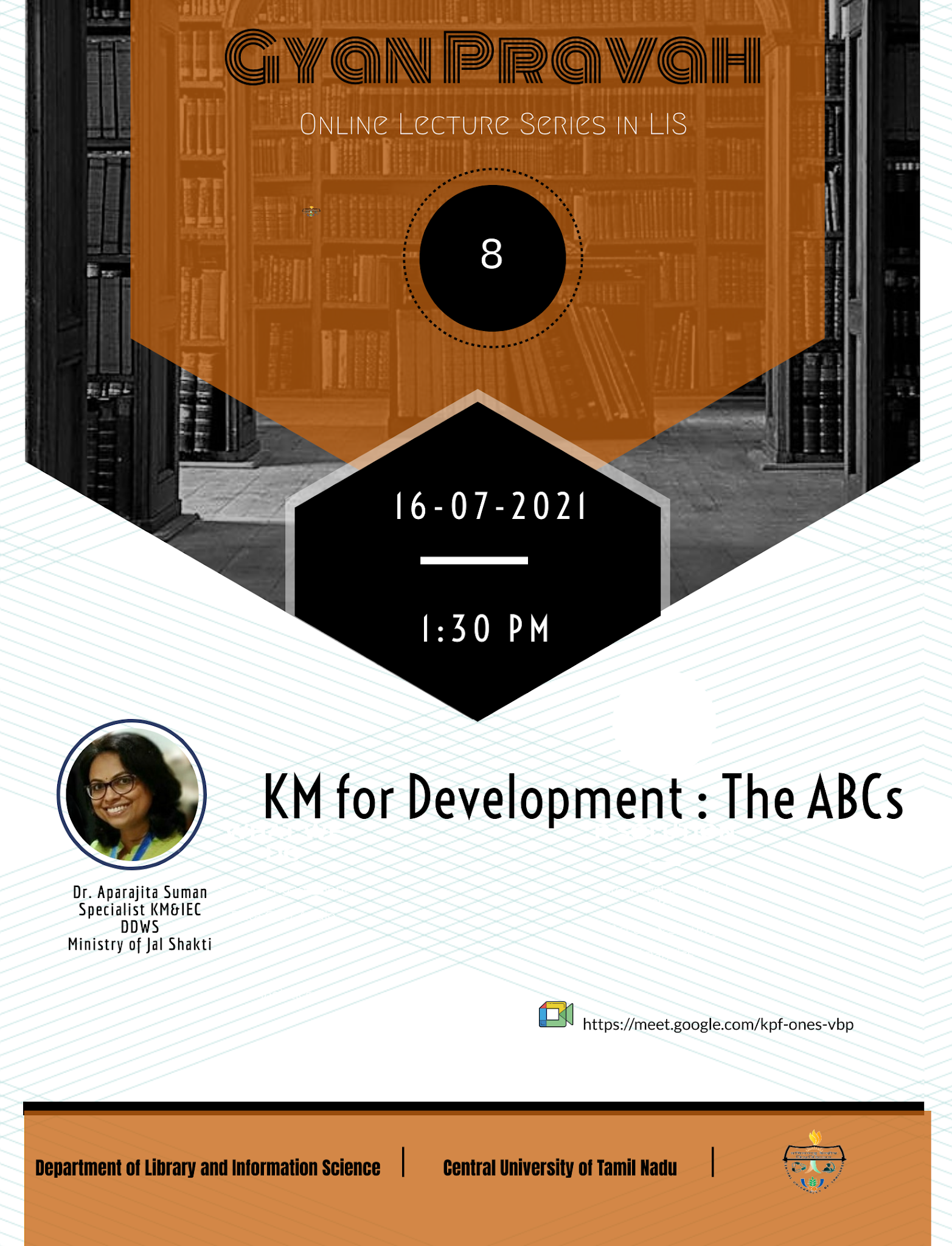
This is to inform you that Department of Library and Information Science, Central University of Tamil Nadu has organized a special online lecture series Gyan Pravah: An Online Lecture Series in LIS. The eighth lecture in the series was organized on 16th July, 2021 (Friday) at 1:30 PM - 2:30 PM through Google Meet. Dr. Aparajita Suman, KM & IEC Specialist, DDWS, Ministry of Jal Shakti, Govt of India was invited as resource person and she delivered the talk on “Knowledge Management for Development: The ABCs”.


The program commenced with a welcome address given by Dr. Akhandanand Shukla, Associated Professor and Head, Department of Library and Information Science, CUTN, Thiruvarur followed by a brief introduction about the resource person Dr. Aparajita Suman.

Dr. Aparajita Suman stared her lecture by giving a brief and eloquent idea about the term “Knowledge Management” and the principles behind it. According to her, Knowledge management is the process of creating, sharing, using and managing the knowledge and information produced in an organization. Further she focused on achieving the objectives of the organization and how to improve the performance and emphasized that KM gives keen attention in delivering right knowledge to the right person in right time. Different types of Knowledge such as tacit (knowledge difficult to express or extract) and the explicit, old and new etc. were also discussed. KM jargons with its purpose and relevance were simplified during the lecture. Different strategies and instruments in KM were also briefly mentioned which includes communities of practice, exit interviews, storytelling, white pages, identifying and sharing best practices etc. Core components required for the development of KM environment such as people, process, technology were mentioned and enlisted some tools and techniques of knowledge management. Some after effects of KM, the way in which it can be measured were explained. The reason for measuring it, how to measure and what to measure, some common approaches in measuring the effects were also discussed. A few questions were asked at the end of the session and those were answered neatly.

The lecture was coordinated by Dr. Anila Sulochana, Assistant Professor, Department of Library and Information Science, Central University of Tamil Nadu, Thiruvarur and attended by 29 participants. The lecture session ended with a formal vote of thanks proposed by Dr. Anila Sulochana. Mr. Abhijith B., Junior Research Fellow, worked as the rapporteur in the program.

The glimpses of the program are given below:


Department congrats to all who attended the program and taken the benefit to listen to Dr. Aparajita Suman on some of the practical aspects of the Knowledge Management.

Thanks.